What is Prepaid Hoster Pro?

Prepaid Hoster Pro is a feature expansion package for our Cloud Manager. We constantly come up with new features that we want to provide to our customers. But at some point, this becomes a problem. More features usually mean increased prices for our servers.

In order for you to continue renting affordable servers, we have created this monthly subscription package where we include some of the new features. This way, customers can still use the familiar features with their servers or enjoy additional features with PPH Pro.

What are the benefits of PPH Pro?

Our web interface – with Prepaid Hoster Pro

Currently, Prepaid Hoster Pro Gen. 1 offers the following benefits:

  • Special modern logo in the web interface
  • Linux Auto Update Manager (NEW)
  • Linux Cronjob & Autostart Manager (NEW)
  • Statistics limit: 90 days instead of 30 days per server
  • Backup limit: 10 backups instead of 5 per server
  • Snapshot limit: 4 snapshots instead of 2 per server
  • Custom logo in the web interface (use your own branding)
  • Customizable design (not just the pre-defined ones)

What’s the future of PPH Pro?

We will continue to add new features to Prepaid Hoster Pro in the future. Each time we introduce a new feature, we change the generation. Currently, we have Prepaid Hoster Pro “Generation 1”.

Currently, we are working on the following features for future versions of PPH Pro:

  • Possible special conditions for specials
  • VHost/Redirection Manager for Apache2 in the Cloud Manager
  • Fail2Ban Manager in the Cloud Manager
  • IPTable/Firewall Manager in the Cloud Manager
  • Free storage extension with remote storage
  • Inclusive domains when purchasing PPH Pro
  • Priority monitoring with intervention in case of unexpected outages
  • Fine-tuning for server threshold values (e.g. info when Load > 2.5 or disk space > 80% occupied)

The features are not sorted by release date or development progress. The list may also change or expand constantly, so please do not consider any of the features as guaranteed. We strive for a high-quality standard, which naturally reflects in the development time.

Upgrade to the latest version

When the functionality expands, the price of the package will also increase. However, you are not forced to upgrade and can stay with the current generation until you decide to upgrade. When a new version is introduced, you will receive a worthwhile upgrade discount for a limited time.

Check out Prepaid Hoster Pro now!

What DDoS protection is available?

If you rent a virtual server from Prepaid-Hoster, you have access to various DDoS protection profiles to protect your applications.

If you are experiencing server accessibility issues due to an attack, you can activate permanent protection. Otherwise, your server is in automatic detection mode 24/7. If you believe your server is not being attacked but still not functioning, check here.

We monitor your server traffic around the clock for unwanted disturbances! DDoS protection is included with all virtual servers from Prepaid-Hoster.

DDoS protection settings

Which DDoS protection provider does Prepaid-Hoster use?

We use DDoS protection from SYNLINQ. Arbor Sightline ensures the availability of your server 24/7.

Which profiles are available?

You can view the status of your chosen AntiDDoS profile in the Cloud Manager. This value is an important part of your server, so we display it directly in the Cloud Manager.

  • Automatic protection
  • General permanent protection
  • Minecraft DDoS protection
  • TeamSpeak protection
  • GTA 5 (Five-M)
  • ALT:V
  • RAGE:MP
  • GTA:SA
  • ARK:SE
  • Steam games (General)

Notifications for attacks

You will receive an email from us if your server is under attack. You can also find information directly in the web interface.

Are there any disadvantages to DDoS protection?

No, there are no disadvantages. The ping may increase by 1-2 ms when protection is enabled. Other programs on the server may potentially cause false positives.

Can I use multiple profiles at once?

No. You can only choose one profile. If you have a service that requires specific protection, it should be on a separate vServer anyway.

Can I install Windows on a Game-Root?

No, it is not possible to install Windows on our Game-Root servers. We cannot make any exceptions in this matter.

Our Game-Root servers have a very powerful CPU performance. This performance belongs exclusively to you. In order to provide you with the best performance for the price, we have decided to only allow Linux operating systems on these servers. Windows consumes valuable resources and we want to avoid that.

If you cannot do without Windows but need sufficient performance, you should consider setting up a Dedicated Server. Although they do not match the CPU performance of the Game-Root servers, they are sufficient for most games on Windows.

Can I Virtualize on My vServer?

No. Nested virtualization is disabled on our KVM vServers. AMD-V and Intel VT-x are not available inside the VM, so Proxmox, Hyper-V, hardware-accelerated VirtualBox or your own KVM guests will not run there. And to be honest: after everything that came to light in 2026, we do not expect to ever enable this feature on shared hosts. If you want to run your own VMs, a dedicated server with virtualization is the right choice.

What do I need virtualization for?

You need virtualization if you want to run additional, fully independent operating systems on your server. Typical tools are Proxmox VE, Hyper-V, VMware ESXi or KVM with libvirt. On a vServer this would be a second layer of virtualization, which is exactly what nested virtualization means: our host runs your VM, and your VM runs its own VMs.

Why is nested virtualization disabled?

The main reason is security. Many customer VMs run side by side on one host. The most important job of the hypervisor is to keep these VMs cleanly separated from each other and from the host. This year, that boundary was broken several times, and every time through nested virtualization.

The vulnerabilities of 2026

  • Januscape (CVE-2026-53359), disclosed in July 2026, CVSS 8.8: a use-after-free in the shadow MMU of KVM on x86, affecting both Intel and AMD. The bug sat in the Linux kernel for about 16 years. A guest with root privileges can crash the host, taking down every other VM on it. According to the researchers, code execution on the host is possible as well. A complete fix also requires the patch for CVE-2026-46113, which affects the same code path.
  • Zapscape (CVE-2026-64561), disclosed in August 2026: again the shadow MMU of KVM on x86, again a use-after-free. This time there is a public proof of concept that demonstrates a full escape from the VM to root on the host, shown on AMD. The affected code dates back to 2020.

Both vulnerabilities share the same precondition: the host has to offer nested virtualization to the guest. Only then does KVM fall back to the old shadow MMU for the nested VMs, and that is exactly where the bugs are. The second precondition is root inside the guest. On a vServer, every customer has root, that is the whole point of a root server. For an attacker, this hurdle is already cleared the moment they order a vServer.

At Prepaid-Hoster, nested virtualization has always been disabled on all hosts. This attack path was therefore never open with us.

And what nobody has found yet

Januscape and Zapscape have been patched. The real problem is a different one: both bugs went unnoticed in the kernel for years, one of them for 16 years. The code path for nested virtualization is old, complex and barely used in normal operation. It would be naive to assume that everything in there has been found by now. And a single escape does not only affect the customer who triggers it, but every VM on the same host.

So our honest answer is: we do not plan to enable nested virtualization on our vServers, and we cannot promise that this will ever change. The risk for all other customers on a host is out of proportion to the benefit for a few.

Do other hosting providers handle this differently?

Some do. But we assume that providers who take their customers’ security seriously handle it the same way we do: nested virtualization stays off on shared hosts. If your provider offers this feature on vServers, it is worth asking how they deal with vulnerabilities like Januscape and Zapscape.

Fair resource usage

There is a second reason as well: virtual servers are built to distribute load at a low price. An additional virtualization layer costs extra performance and makes the load on a host hard to plan. Without nested virtualization, performance stays stable for all customers on a host.

Can I use Docker?

Yes. Docker does not need hardware virtualization, because containers share the kernel of your vServer. Docker runs on our KVM vServers without restrictions. You can find the setup in Can I Use Docker on My vServer?

The same goes for other container solutions like LXC or Podman. For many cases where people instinctively think of a VM (separate services, test environments, several projects on one server), containers are perfectly sufficient.

Pure software emulation, for example QEMU without KVM acceleration, does start without AMD-V or VT-x. For serious use, however, it is far too slow.

The solution for your own VMs: dedicated servers

If you really need your own virtual machines, for example for Proxmox, Hyper-V, a homelab in the data center or VMs for your own customers, go for a dedicated server. There the entire hardware is yours, and AMD-V or Intel VT-x are available without restrictions.

And this also makes sense from a security point of view: on a dedicated server you share the hypervisor with nobody. Even if an escape were to happen in one of your VMs, it would only affect your own system and no other customers. Whether all patches are installed is up to you.

  • Around 100 configurations, locations Falkenstein and Nuremberg
  • Prepaid as usual, no contract lock-in
  • Delivered in rescue mode, installation via the Dedicated Cloud Manager
  • Unmanaged: we take care of the hardware and its availability, you manage the operating system and your VMs

Whether your preferred configuration supports virtualization is covered in Does my dedicated server support virtualization?

Further reading
Are all ports open?

Yes, all ports are open on our servers. You have no restrictions. The software firewall (iptables) is set to “ALLOW” by default.

So if you start a program on your Linux server that opens a port publicly, you do not need to explicitly open it. So you don’t need to perform explicit port forwarding, as you might have to do at home, for example.

It’s a bit different with Windows servers. There, you need to open the ports in the Windows firewall to be able to reach them from the outside.

My program is not accessible from the outside

If your program is not accessible from the outside, first check your firewall. Usually, however, the issue lies with the program’s listening method. If the port is open on “127.0.0.1”, you can only access the port from the machine itself. You would need to either set your own IP address as the “bind” IP or use “0.0.0.0”. This will make your program accessible from the outside.

We also have a separate article on making a MySQL Server accessible from the outside.

How do I install PHPMyAdmin on my server?

PHPMyAdmin is a popular web-based open source application designed to manage MySQL databases. It allows users to conveniently manage databases through a web-based graphical user interface (GUI).

You can install phpMyAdmin fully automatically with root access in our web interface on any debian-based Linux.

To do this, go to the Cloud Manager of your server.

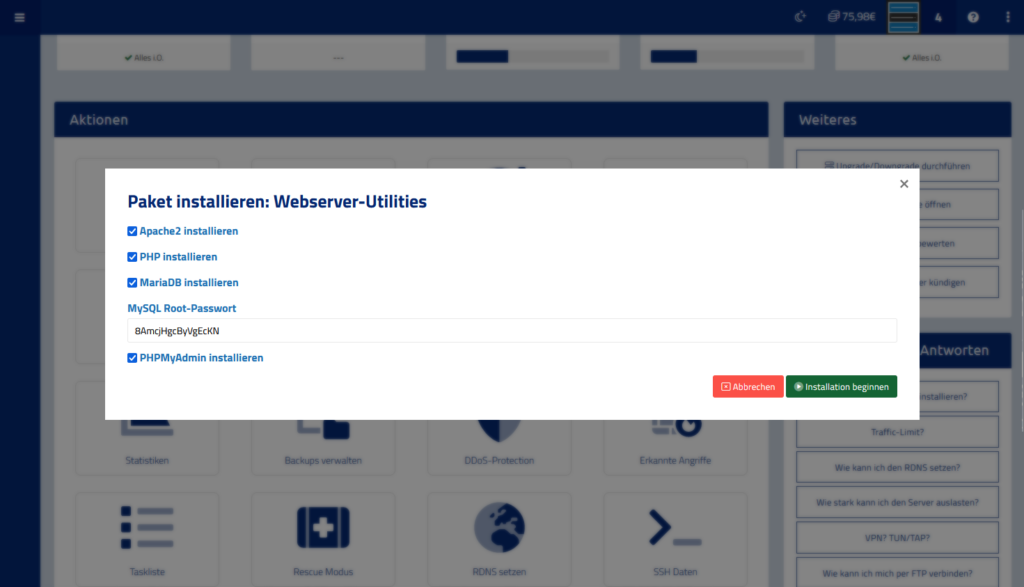
Scroll down to the Actions and select “App Installer”. There you click on the “Web Server Utilities”.

Install webserver Utilities

In this dialogue you have to select everything. This is because phpMyAdmin requires a web server (apache2), the PHP script engine and the database software MariaDB/MySQL server.

Then click on Start installation.

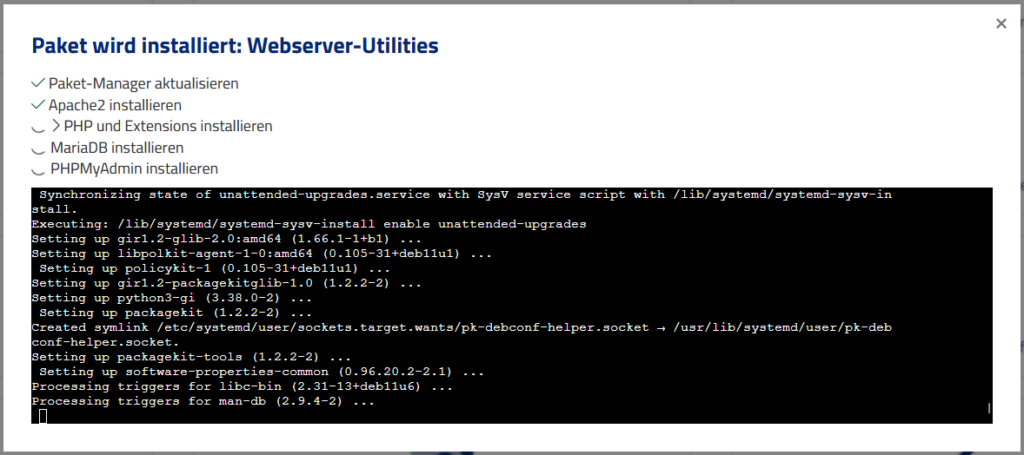
Running Webserver Utilities installation

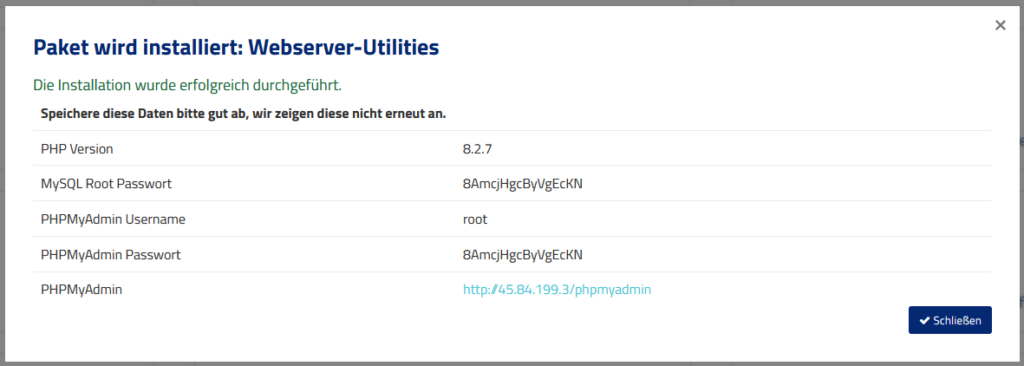
Now you only have to wait a short time until your installation is finished. You will then be shown all the data you need to access your database.

phpMyAdmin access details

How do I create a DKIM?

DKIM is an important method for securing email communication and preventing email fraud. In this article we will take a closer look at DKIM, how it works, why it is relevant for your Plesk server and how you can implement it effectively.

When sending and receiving emails through your Plesk-based hosting service, it is essential to ensure the security and authenticity of your emails. Read on to learn more about DKIM and how you can protect your email communications.

Required for many email providers

Mail providers, such as Google’s gmail, no longer accept emails without a valid DKIM. This is how companies proceed to protect their customers from mail spam.

Where can I find the DKIM in Plesk?

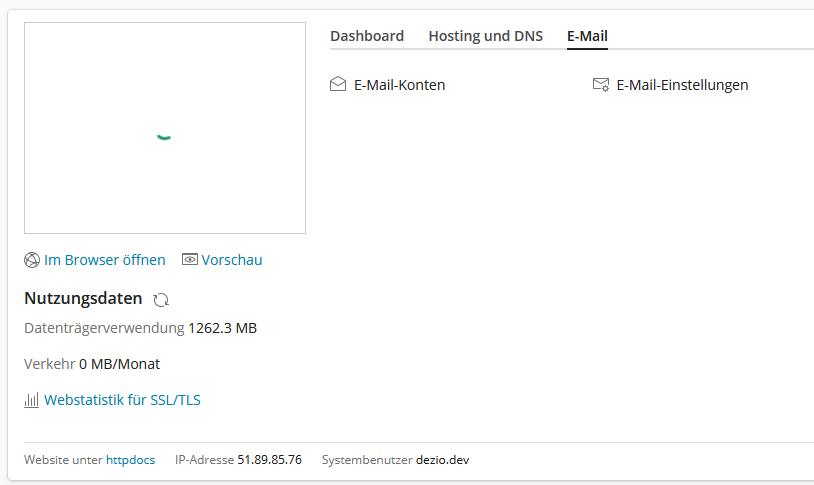
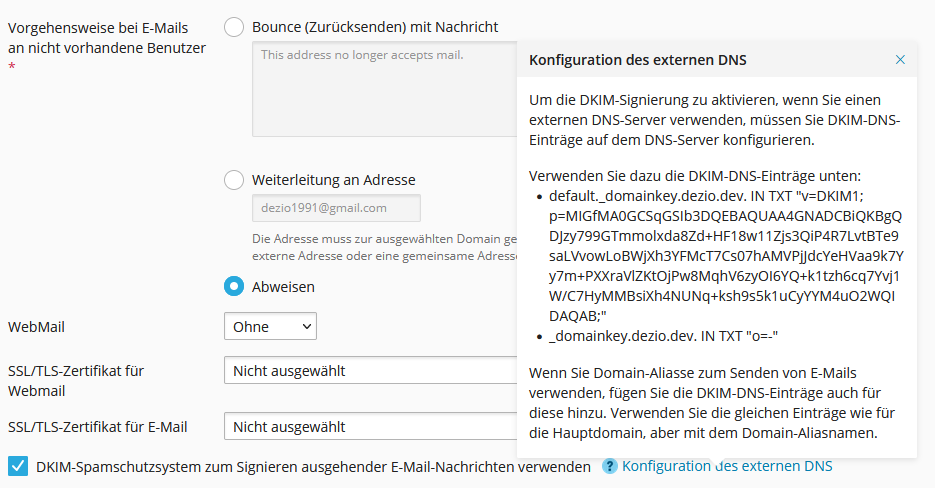
Step 1: Log in to Plesk and navigate to your domain. Click on the “Email” tab and then go to the “Email settings”.

Plesk E-Mail Settings

Step 2: In the settings, activate the check mark for “Use DKIM spam protection system to sign outgoing e-mail messages”. Then click “Apply”.

Step 3: Click on “Configure external DNS” to get the key information for your DKIM:

DKIM Key

You need:

  • default._domainkey.dezio.dev. IN TXT "v=DKIM1; p=MIGfMA0GCSqGSIb3DQEBAQUAA4GNADCBiQKBgQDJzy799GTmmolxda8Zd+HF18w11Zjs3QiP4R7LvtBTe9saLVvowLoBWjXh3YFMcT7Cs07hAMVPjJdcYeHVaa9k7Yy7m+PXXraVlZKtOjPw8MqhV6zyOI6YQ+k1tzh6cq7Yvj1W/C7HyMMBsiXh4NUNq+ksh9s5k1uCyYYM4uO2WQIDAQAB;"
  • _domainkey.dezio.dev. IN TXT "o=-"

How do I store the DKIM in the DNS Manager?

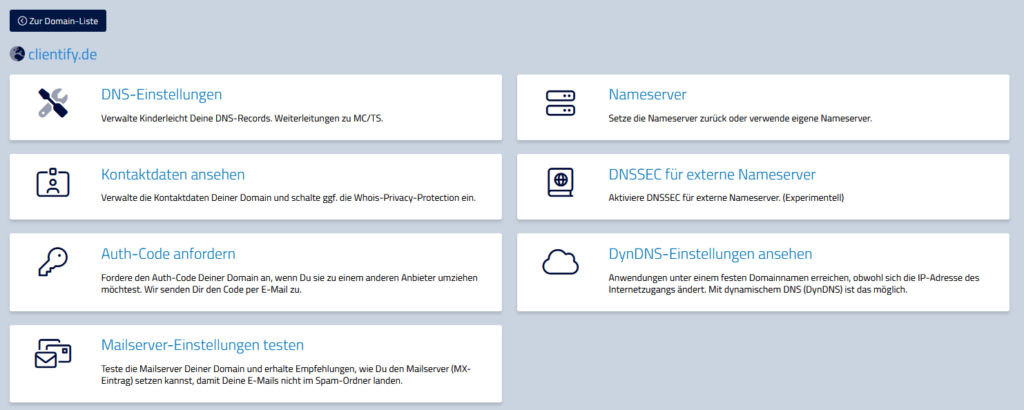
Now open Vionity and search for your domain in the navigation. Click on the corresponding DNS management.

Vionity Domain Management

Then click on “+entry”.

Add the default._domainkey key:

  • Record-Type: TXT
  • Name: default._domainkey
  • Content: The key provided by plesk "v=DKIM1; p=MIGfMA0GCSqGSIb3DQEBAQUAA4GNADCBiQKBgQDJzy799GTmmolxda8Zd+HF18w11Zjs3QiP4R7LvtBTe9saLVvowLoBWjXh3YFMcT7Cs07hAMVPjJdcYeHVaa9k7Yy7m+PXXraVlZKtOjPw8MqhV6zyOI6YQ+k1tzh6cq7Yvj1W/C7HyMMBsiXh4NUNq+ksh9s5k1uCyYYM4uO2WQIDAQAB;" (mit Anführungszeichen!)
  • Save!

Then create the _domainkey:

  • Record-Type: TXT
  • Name: _domainkey
  • Content: "o=-" (mit Anführungszeichen!)
  • Save!

Your DKIM is now stored. The reliability of your e-mail delivery is now increased. Please note, however, that there may still be problems with sending e-mails, as many other factors play a role.

Prices for additional products for dedicated servers

You can order additional hardware for your server via the customer support. For example, additional hard disks are available if you run out of storage space.

Upon installation, the monthly price plus the set-up fee is due once. The order is only confirmed when the credit is available.

Additional hard disks

You can have us install additional hard disks in your dedicated server. Whether and for how many additional hard disks can be installed varies from server to server. For example, it may be that your server was already delivered with 3 hard disks and the motherboard does not allow any more space for storage media.

Hard diskmonthlyone-time setup
1,92 TB SATA SSD DC Edition29,40€10,00€
3,84 TB SATA SSD DCEdition49,03€10,00€
2 TB SATA Enterprise HDD16,78€10,00€
6 TB SATA Enterprise HDD 21,66€10,00€
12 TB SATA Enterprise HDD 28,56€10,00€

If you want to install one or more additional hard disks, contact Support. We will then check what is possible for your server.

Can I change the billing address?

Yes, you can change or determine the address on your invoices. If your current address or company name is incorrect, please first change your address in the web interface.

You can also directly specify a VAT ID there. This will be displayed on all subsequent invoices, along with the company name.

Adjust existing invoice

To change the address (including company name and VAT ID) on existing invoices, you need to briefly contact customer support. The address on existing invoices is not automatically changed if you modify it in the web interface due to legal regulations. An employee in the accounting department will take care of that for you.

Please note that we only update the address on top-up invoices. All other invoices have been paid with credit and are not suitable for your own accounting.